

An unfinished basement featuring concrete block walls, exposed floor joists, and a metal forced-air furnace with ductwork near a central pillar.

Furnace Maintenance in Great Falls, MT

Tell us about the job

Takes about a minute. No obligation.

Tune-up, service, or cleaningFurnace or heatingCascade County, MT
Step 1 of 2

What ZIP code is the job in?

Montana gas ran $7.77 per million Btu in 2024, among the higher prices in the country. A furnace that's skipped its yearly check works harder to put out the same heat, and every extra cubic foot it burns costs more here than it would somewhere cheaper. A dirty burner or a clogged filter doesn't just wear the furnace down. It shows up on the gas bill every month of the winter. Keeping the furnace tuned is one of the few things that actually controls what Great Falls winters cost you.

Furnaces in Great Falls start working in September.

Get the furnace looked at in August, before it has to carry the first cold mornings.

Half these furnaces are older, and old furnaces need more watching, not less

Half the homes here were built by 1970
Climate zone 6B
Heat runs September through June

Almost three out of every four homes in Cascade County heat with gas, and that's what a furnace tune-up here is really about. A gas furnace draws air in to burn fuel and vents the exhaust back out, and both sides of that have to work right. The burner needs to be clean enough to light evenly. The flame sensor needs to read the flame correctly. The venting needs a clear path to the outside, with no blockage or corrosion forcing exhaust where it shouldn't go. A filter swap doesn't touch any of that. A real tune-up checks the burner, the ignition, and the vent together, because on a gas system those are the parts that decide whether it runs safely and burns fuel the way it should.

A tuned furnace is what keeps Great Falls winters affordable

A tune-up gets the burner and ignition back to burning gas the way they should. That's what keeps the extra cost off a Great Falls gas bill.

Find a contractor
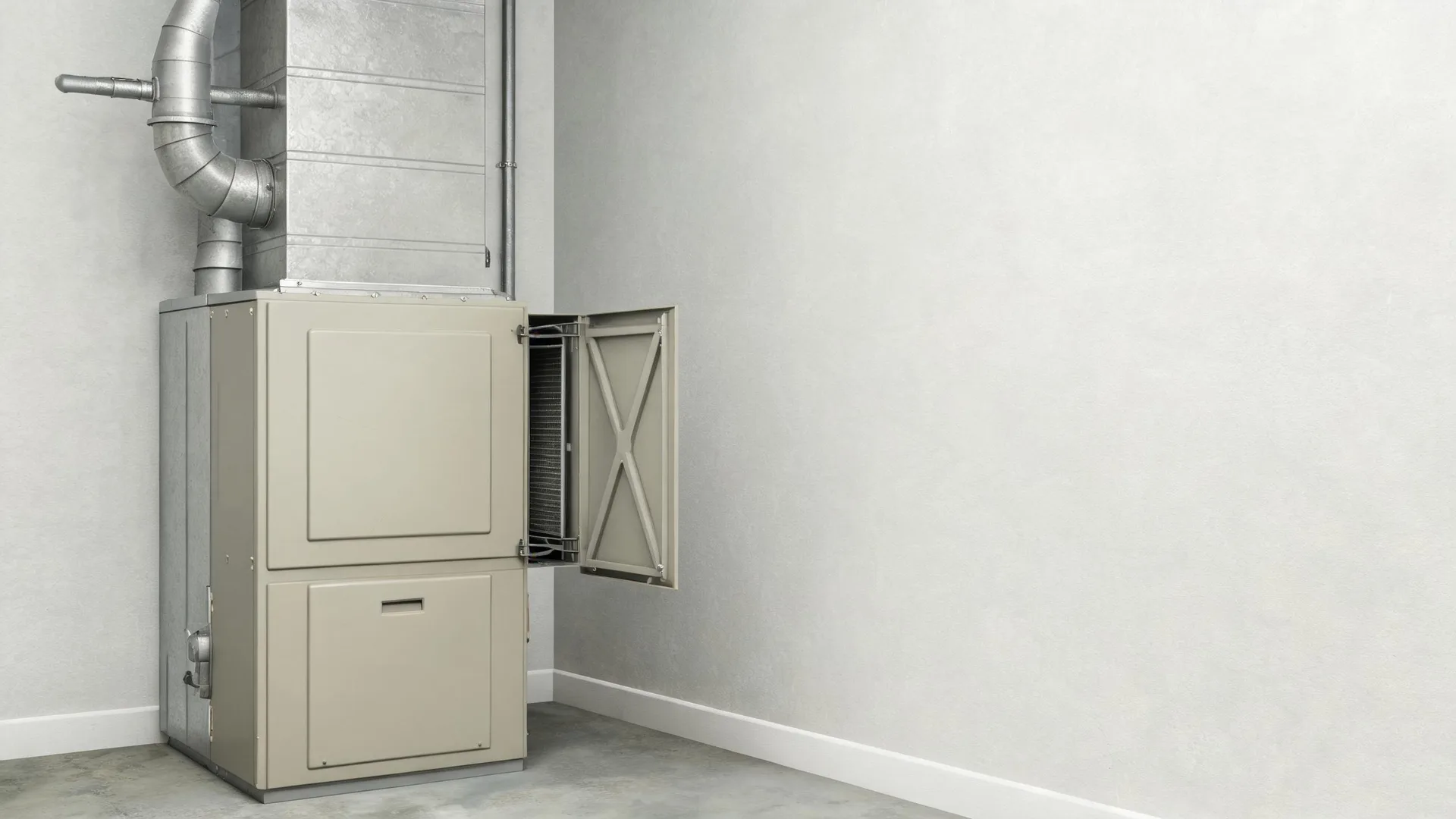
A gray residential gas furnace installed in an unfinished basement, connected to sheet-metal ductwork and PVC pipes.

Ten Months On, Two Months Off

Ten months a year, this furnace is doing something. September through June, it's cycling on and off to keep the house warm. Two months off is not much time for a system to rest before the next stretch starts. That long a run puts real hours on the burner and the igniter, and it means whatever is wearing out has less time to wait before it gets asked to work again.

The filter protects the blower, not the burner

A clogged filter chokes off airflow across the heat exchanger. The blower has to push harder to move the same air, and the air coming off the furnace runs hotter than it should. Left long enough, that heat can trip the limit switch and shut the furnace down mid-cycle. Swapping the filter is the easy part of upkeep, but it only guards one side of the furnace.
The heat exchanger is the part a tune-up is really checking

Heat moves from the burner into the exchanger, and from the exchanger into the air the blower sends through the house. A crack in that metal lets exhaust mix into the air supply instead of going out the vent. There's no filter or coil to catch that. It's found by someone looking at the exchanger directly, which is the reason a tune-up matters more than a filter change ever will.

Skip a season or two and a furnace doesn't quit outright. It drifts. The igniter takes an extra try or two to catch. The burner flame goes ragged and yellow at the edges instead of burning even and blue. Dust builds on the blower wheel and in the ducts, so the blower works harder to move the same air through the house. None of that trips a breaker or shuts anything down, so it keeps running like that for months, sometimes years. The furnace doesn't fail. It just stops doing the job as well as it did, and nothing tells you until the gas bill does or the part finally gives out mid-winter.

September is close. Once the furnace starts its ten-month run, there's no real gap to get it looked at without pulling it out of service for a day. A check now catches a cracked exchanger, a weak igniter, or a burner that's not lighting clean, before any of that has to carry a Great Falls winter. Wait until the first cold snap and whatever's already worn gets asked to work anyway. That's a harder way to find out something needed fixing.