Why your propane furnace won't light in Ennis, MT
A propane furnace that won't light is usually stuck on either the igniter or the gas supply. Most furnaces now use a hot surface igniter instead of a standing pilot, and that igniter weakens with age until it can't get hot enough to catch the gas. The flame sensor can also be coated with a thin film that makes it think no flame is present, so the furnace shuts the gas valve right back off. Both failures look the same from where you're standing: the furnace tries, clicks, and goes quiet. Cold snaps here make this worse. A furnace running nonstop through a hard Madison County winter puts more cycles on the igniter than one that only kicks on now and then, so the part wears out faster right when you need it most. If the burners never even attempt to fire, it's worth checking that your propane tank still has fuel, since a tank running low can read the same as an ignition failure from inside the house.
Winter nights around Ennis average 14°F, according to National Weather Service data for Madison County. At that temperature your furnace isn't cycling on and off a few times a day, it's running long stretches just to hold the house. That puts more hours on the igniter and more strain on the gas valve than a mild night ever would. A weak igniter that still manages to catch on a 30°F evening often won't get hot enough once the air coming into the furnace is this cold. If your furnace has been slow to light or skipping on the first try, a hard freeze is usually when it finally quits for good.
NOAA nClimDiv 1991-2020
Is this just a clogged pilot, or something worse?
Walk up to the furnace and listen. You might hear the inducer motor hum, then clicking from the igniter, then nothing. Or it stays dead quiet from the start, which usually points to the thermostat or the power to the unit rather than the burner itself. Check the flame too, if it lights at all. A flame that's mostly yellow instead of blue means it isn't burning clean, and that's worth a call on its own. With nights near Ennis dropping into the teens, a furnace that won't catch isn't a small annoyance. Pipes in an unheated space can freeze within a day if the house goes cold, and that's a second repair stacked on top of the first.
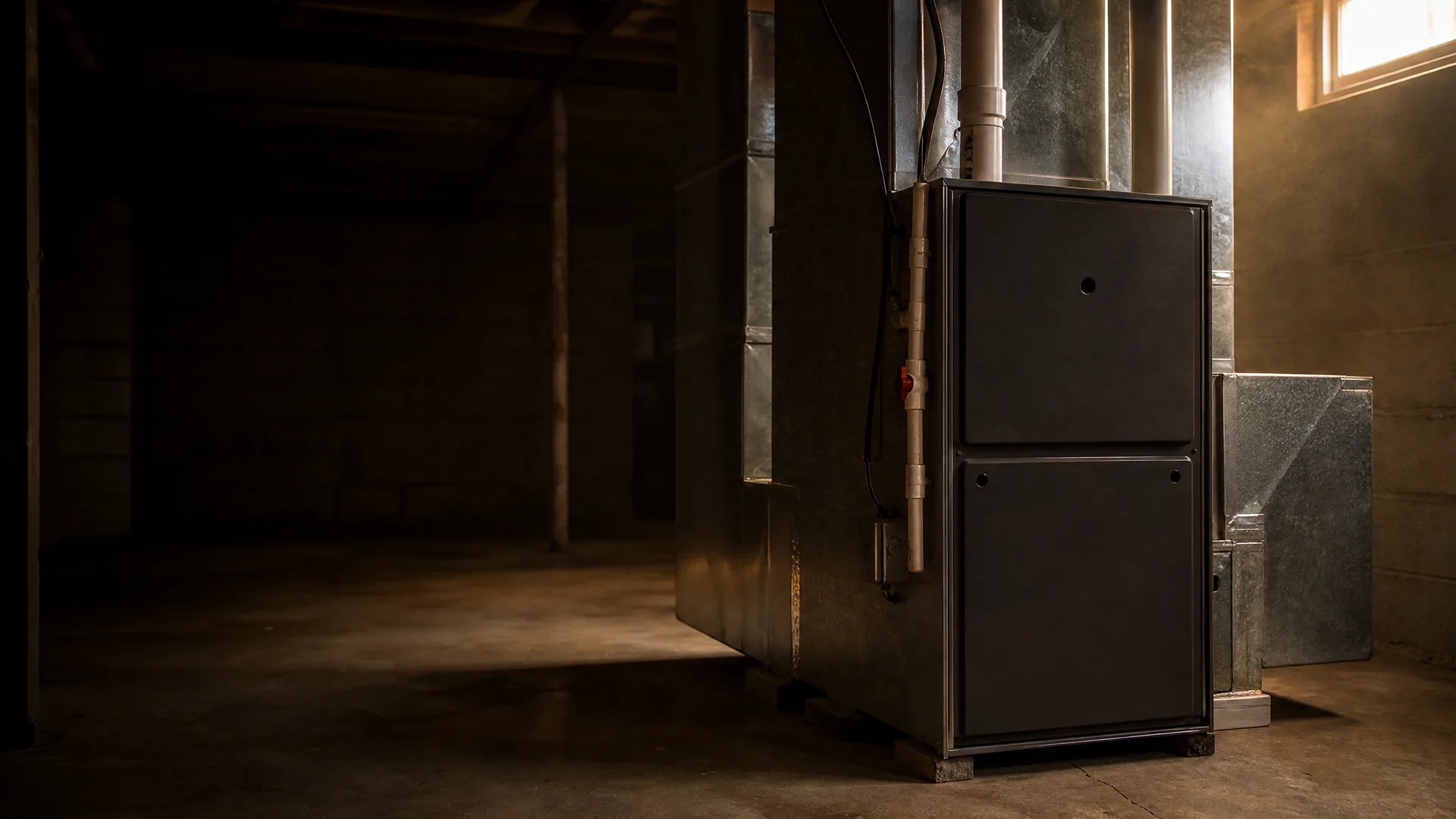
You go down to the basement a little after six, the sky outside already dark the way it is by November. The air near the furnace has a faint haze of dust, stirred up when you came down the stairs. You can feel the cold coming off the ductwork before you even touch the cabinet. You flip the switch on the side, then the thermostat up five degrees, and wait. No hum, no click, no rush of air. Just the furnace sitting there dark, the way it's sat since you first noticed the house feeling colder than it should an hour ago. Outside the window the thermometer reads somewhere near 14. You stand there a minute longer, listening for anything.
Igniter or Gas Supply
Igniter problem
- The furnace tries to start, the inducer motor runs, but no flame ever catches, so it locks out after a few tries.
- A hot surface igniter glows for a second or two and then goes dark instead of holding steady long enough to light the gas.
- This part fails a little more each time it heats up, so a furnace that lit fine last winter can simply stop working this year.
- You can sometimes see the igniter glow faintly orange through the view port, weaker than it should be, right before the furnace gives up.
- Replacing it is a straightforward repair once a contractor confirms that's the part at fault, not the gas valve or the control board.
Gas supply problem
- The furnace goes through its whole startup sequence, inducer and igniter both, but there's no gas reaching the burner to light.
- A propane tank that's run low or empty will starve the furnace even though every electrical part is working the way it should.
- A gas valve that's failed to open, or a line with air in it after a tank refill, can leave the igniter heating nothing.
- If the smell of propane shows up near the furnace, that points to a leak and means shutting the system off until it's checked.
- Checking the tank level is something you can do yourself before anything else gets ruled out.




Get matched with a furnace pro in Madison County
A furnace that won't light in a house this cold doesn't wait well. At 14°F outside, the house starts losing ground within a few hours, and by the next morning that gap is hard to close back up with space heaters alone. You can check the igniter yourself if you're willing to pull the panel and look, but a cracked igniter and a failed gas valve look a lot alike from where you're standing, and guessing wrong means a second trip and a second part. A licensed contractor who works on propane furnaces around Madison County carries both parts on the truck and knows which one your model tends to fail on first. Sending the request means you stop running through possibilities in your head at 9pm and someone who's seen this furnace before takes it from here.
Why the igniter fails first
A hot surface igniter is a thin strip of silicon carbide or silicon nitride that heats up when the furnace calls for heat. Every cycle flexes it as it heats and cools, and after enough cycles it develops a hairline crack you can sometimes see if you look closely with the power off. Once that crack forms, the igniter either won't glow at all or glows too weak to reach the temperature needed to light propane. There's no fixing a cracked igniter. It gets replaced. The part itself is inexpensive, but matching the right igniter to your furnace model matters, since the mounting bracket and the electrical connector vary between manufacturers.
What a lockout actually means
Furnaces built in the last couple decades track failed ignition attempts and shut themselves down after three or four tries rather than keep dumping propane into the burner compartment unburned. That's the lockout. It's not a separate problem, it's the furnace's own safety response to whatever is already wrong, whether that's a weak igniter, a dirty flame sensor, or low gas pressure. Resetting the thermostat or flipping the breaker clears the lockout and lets it try again, but if the underlying issue is still there, it'll just lock out a second time. Each attempt also puts a burst of propane into the chamber, so repeated cycling without a fix isn't something to leave running overnight.


What This Comes Down To
- A furnace that won't light almost always comes down to the igniter or the gas supply, not something bigger.
- A cracked igniter or a weak flame sensor signal can be confirmed or ruled out in one visit.
- At 14°F overnight, a house without heat loses ground fast, so waiting it out costs more than calling.
- Once a licensed contractor is matched to the job, you're no longer the one tracking down who's available.
- Most lockouts trace to a part that fails slowly over years, so a repair now usually settles the problem.
- Knowing which symptom you're seeing, clicking with no flame or dead silence, already narrows down the likely cause.
A furnace that won't light in Ennis almost always traces back to one of two places: the igniter that's gone weak, or a gas or airflow problem keeping the burners from getting what they need to catch. That's true whether yours clicks and clicks with no flame or just sits there silent. Neither one is a mystery once someone's standing in front of the unit with a meter, and neither one usually means the furnace itself is done. These parts fail slowly, over years of cycling on and off, and by the time one quits for good it's typically just that one part, not the whole system.
What makes this worth acting on tonight rather than tomorrow is the math outside. At 14°F, a house with no heat doesn't hold its temperature for long, and the colder it gets inside, the harder everything is to bring back, pipes included. Waiting it out with a space heater or two buys a little time, not a solution.
Sending the form is where your part of this ends. Instead of calling around Madison County trying to find someone free tonight, you hand that search off, and a licensed contractor who works on these systems gets matched to the job and reaches out to you. The furnace still needs a real diagnosis, but finding who's going to give you one stops being something you have to manage yourself.





A local pro for your furnace repair
Send the request today and stop worrying about who to call.
Sending the form costs nothing.