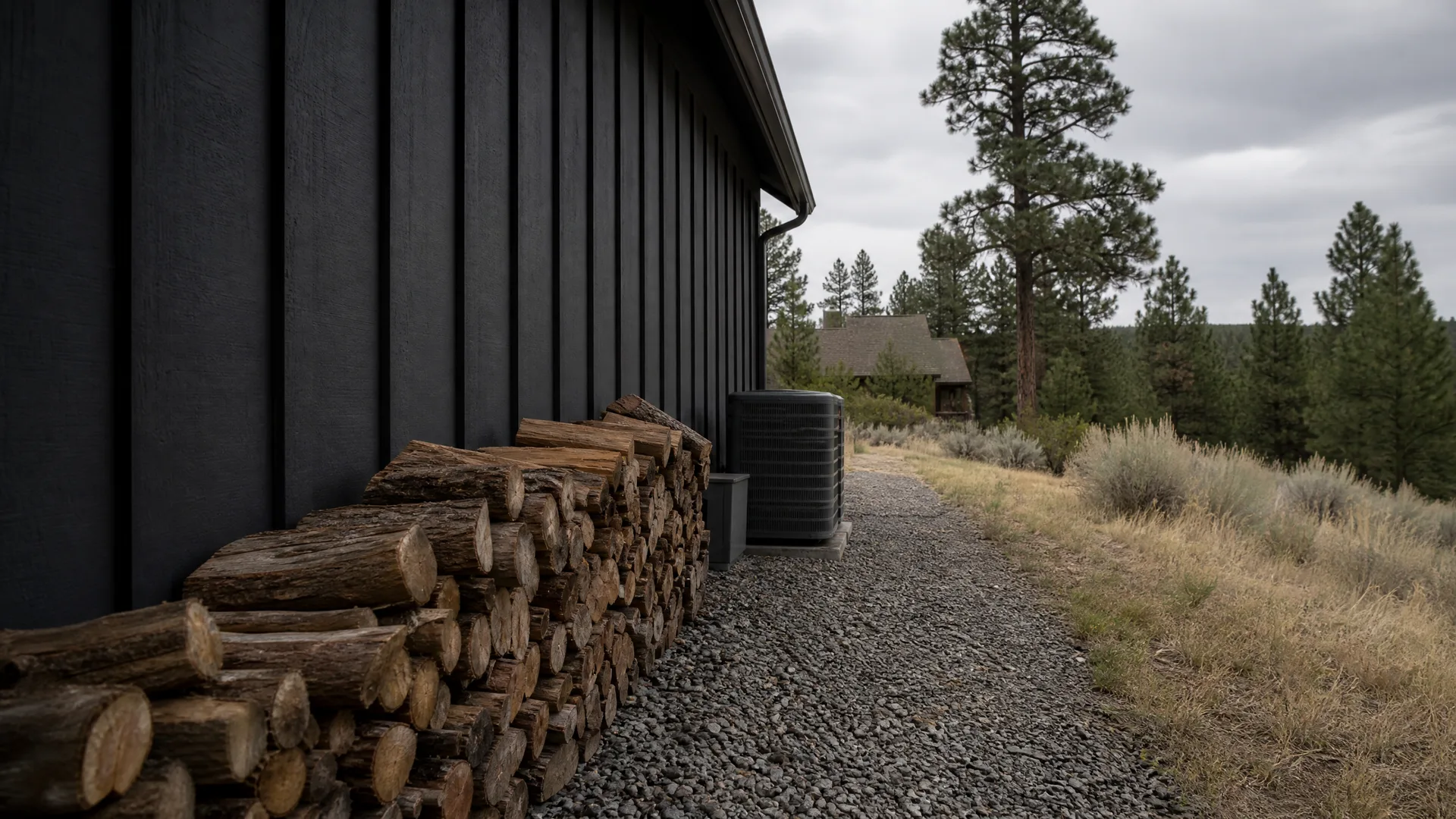
Stacked firewood along the dark vertical-board wall of a house beside a gravel path with two outdoor condenser units, with pines, dry grass and an overcast sky beyond.

Heat Pump Repair in Shelby, MT

Tell us about the job

Takes about a minute. No obligation.

RepairHeat PumpToole County, MT
Step 1 of 2

What ZIP code is the job in?

Wind takes a toll on the outdoor unit

Toole County recorded damaging wind 168 times between 2015 and 2024. The outdoor unit sits through all of it, year round, and that kind of repeated strain on the cabinet and fan wears a heat pump down faster than it would somewhere calmer.


A breakdown is rarely bad luck

When a heat pump here starts short cycling, losing heat, or blowing warm air in July, the cause usually traces back to stress the unit has been under for a while. A proper diagnosis finds what actually failed, not just the symptom, so the repair holds.

10 months
September through June, your system heats
1 months
July through July, it cools
10°F
the average winter night it heats against
78°F
the average summer afternoon it cools against
Isometric grayscale illustration of a cutaway two-story house showing interior ductwork, an indoor air handler unit, and an outdoor condenser unit on a pad beside the building.
Your system heats September through June and cools July through July.

NOAA nClimDiv, 1991–2020 normals

Half the homes in Toole County were built in 1966 or earlier.

A heat pump in a house that old is more likely nearing the end of its working life than one installed in a newer build.

Toole County sees this kind of weather almost every year

185 severe weather events from 2015 to 2024
18% of homes statewide lost power a day or more in 2024
168 damaging wind events from 2015 to 2024
A failing heat pump costs you every month it runs like thisElectricity here runs 10.84 cents a kilowatt-hour, cheaper than most of the country, but a heat pump struggling to keep up still runs up a bigger bill than it should.

Heat here almost never stops. Homes in Toole County run it from September through June, so August is the only real break the system gets before the load comes back. A heat pump that's been limping along tends to show it in those first September weeks, when it switches over and has to carry the house again. Overnight lows average 10°F through December, January and February, and a unit with a weak component often makes it through the mild stretch only to fail once the hard cold sets in. If yours is already acting up now, before the season has even asked much of it, that's worth paying attention to.

Get it diagnosed before Toole County weather makes the problem worse

Get the outdoor unit checked before the wind and cold put more strain on whatever's already worn. A technician can find the actual cause and fix it so it holds through winter.

Find a contractor
A gray air-source heat pump mounted on a concrete pad next to a house with gray vinyl siding, surrounded by gravel and flanked by green shrubs and white hydrangea flowers.

Ask how much life is left before you pay for the fix

If your house dates back to 1966 or earlier, the heat pump in it has likely already had one or two replacements since the house was built. That doesn't tell you where this particular unit stands, but it's a reason to ask the technician straight out how much life is left in it. A repair makes sense on a unit with years ahead of it. It makes less sense on one that's already near the end, especially with winter still ahead.

It won't hold a temperature

A heat pump that used to keep the house steady and now swings a few degrees either way has lost some ability to modulate. Sometimes that's a failing reversing valve stuck between modes. Sometimes it's a sensor feeding the control board bad information. Either way, the system is working harder to do less, and that pattern tends to get worse, not better.

The sound changed before the problem did

Compressors and fans usually warn you before they quit. A new rattle, a grinding noise on startup, or a hum that won't turn into a run means something is binding or wearing down, often a motor bearing or a loose blade. Catching that sound early and getting it looked at is almost always cheaper than waiting for the part to seize.

Most heat pump failures start small and get ignored. The capacitor weakens and the compressor struggles to start, drawing harder each time until it trips the breaker or burns out. A refrigerant leak drops the charge low enough that the system can't move enough heat, so it runs long cycles and still falls short. Contactors pit and stick from years of cycling on and off, and when they stick closed the outdoor unit keeps running even when it should shut off. Defrost boards fail quietly, and a unit that can't clear frost off the outdoor coil loses capacity until it's barely heating at all. None of these show up overnight. They build for a season or two before the system finally can't compensate anymore.

A heat pump that's struggling doesn't pause the bill while it figures things out. It keeps pulling power to chase a temperature it can't quite hold, cycling longer and more often than it should. That adds up fast when the unit is already running most of the year here. Getting the actual fault fixed, the weak capacitor, the low charge, the stuck contactor, stops the waste at the source instead of letting it run up your bill until the thing quits outright.