Get matched with a pro who works on furnaces in Lewis and Clark County.
A furnace that's struggling in January in Helena is not a thing to gamble on. Winters here are hard, and most homes in Lewis and Clark County heat with gas, which means when the furnace falters, there's no easy backup to lean on while you sort out what to do.
Whether to repair or replace comes down to specifics that aren't the same for every house: how old the unit is, what's failed, whether this is the second or third repair this winter. A furnace that's ten years old and needs an igniter is a different call than one that's older and needs a cracked heat exchanger replaced. There isn't one right answer that applies to every home in Helena, only the right answer for yours.
Getting to that answer usually means calling around, explaining the same problem to three or four companies, and trying to make sense of quotes that don't line up because nobody looked at the same thing. That's the part that eats a weekend, not the decision itself.
This page connects you with a contractor who takes on that part. They'll look at your furnace, your situation, and tell you straight whether it's worth repairing or whether replacing it is the better move. You explain it once. No cold calls to five different places, no guessing which quote means what.
From there, it's between you and the contractor who reaches out. What they find and what they recommend is particular to your furnace and your house, not a script. The work below walks through how to think about repair versus replace in a Helena winter. What happens after that is a conversation with someone who's looked at your system, not another search.
Repair if the furnace is under ten years old and the fix is a single part: an igniter, a flame sensor, a draft inducer motor. Replace if it's cycling on and off, running up your gas bill, or if the heat exchanger is cracked, since that's a safety issue and not a repair. Age matters here because a furnace that quits in Helena in January leaves you with no good backup while you figure out next steps, and most homes in Lewis and Clark County don't have a second heat source to fall back on. A furnace near the end of its life tends to fail at the worst time, during a cold snap, when demand on it is highest. If yours is older and already needed a repair last winter, that's usually a sign the next call will be about replacing it instead. Either way, the part that matters is getting someone out to look at it before the next cold stretch, not after.
A cracked heat exchanger is not something a contractor patches and sends you on your way. It means combustion gases can leak into the air your house breathes, so the furnace gets replaced, not repaired.
Age matters because parts wear out together. A furnace past fifteen years that needs a major repair is usually close behind on the blower motor or the heat exchanger, so replacing it now can mean not paying twice.
How cold and how long does your furnace have to work here?
Winter nights average 15°F
Winter nights here average 15°F, which is why a furnace that can't hold a steady flame or keeps tripping out leaves a house cold fast.
Heat runs September through June
Heat runs September through June in Lewis and Clark County, so a furnace that quits doesn't get much of a break before it has to start again.
56.6% of homes heat with gas
56.6% of homes here heat with gas, same as yours, which is why a contractor who works on furnaces every day isn't hard to find.
NOAA nClimDiv 1991-2020 · ACS 2020-2024
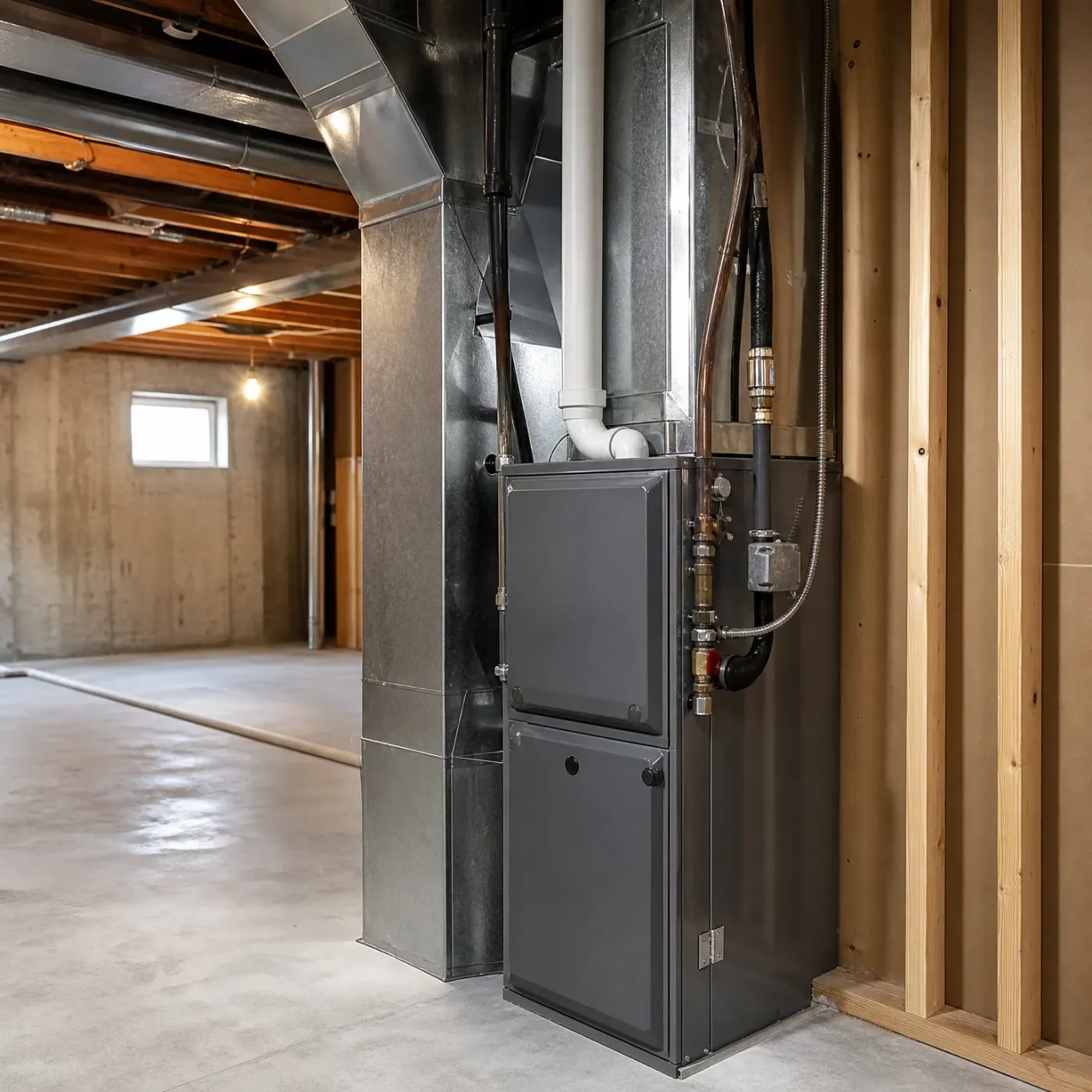
Furnace running right
This is what a furnace should look like after ten years: steady cabinet, tight connections at the gas line and exhaust, no rust on the floor beneath it. If yours still looks like this and the only trouble is a part gone bad, a repair makes sense.
Furnace in trouble
An older furnace with a flexible conduit patched in and a drain line running loose toward the floor has usually got more than one thing wrong with it. Once a furnace this age starts needing attention, the next failure is rarely far behind, and that's the point where replacing it costs you less than chasing repairs.
Before you get your furnace installationAfter you get your furnace installation
The right pro for this job
Describe the project once instead of to every installer.
A local installer who puts in furnaces gets your project.
Clean lines at the ducts and flue, no rust on the floor, gas line secure: this furnace is doing its job.
A unit set on a pallet with no permanent hookup yet is a furnace waiting to be put in, not one that's failed.
How a gas furnace fires
Gas flows to the burners only after the inducer motor proves it can pull exhaust through the flue, which a pressure switch confirms before the igniter gets power.
The igniter glows for about 30 seconds, then the gas valve opens and the flame sensor has roughly 4 seconds to detect a flame or it shuts the gas back off.
A flame sensor coated in a thin layer of oxidation reads the flame as absent even when it's burning, so the furnace shuts down and tries again.
The limit switch cuts gas to the burners if the air inside the furnace runs too hot, which usually means the blower isn't moving enough air past the heat exchanger.
Short cycling often traces back to a dirty filter restricting airflow, not to the burners or the gas valve themselves.
A furnace that locks out after three failed ignition attempts is designed to do that, so a repeated lockout points to a part that needs replacing, not a fluke.
A furnace doesn't just light and run. It checks itself at every step before it lets gas near a flame. The inducer motor starts first, pulling air through the flue, and a pressure switch has to confirm that draft is there before anything else happens. Only then does the igniter get power, glowing for about 30 seconds before the gas valve opens. From that point the flame sensor has roughly 4 seconds to prove a flame is burning, or the valve shuts again. That sensor is a thin rod sitting in the flame itself, and it works by reading a tiny electrical signal through the fire. Oxidation builds up on it over time, a dull gray film that blocks the signal even though the flame is right there. The furnace reads that as no flame and shuts down, then tries again. Try three times and fail, and the control board locks the whole system out rather than keep attempting it. That's not a malfunction so much as the furnace doing exactly what it was built to do when a part isn't holding up its end. The limit switch works the other side of the problem, cutting gas if the air inside the cabinet gets too hot, which is usually the blower not moving enough air past the heat exchanger. And a lot of short cycling that looks like a burner problem or a gas valve problem turns out to be a dirty filter choking off airflow instead.
Winter nights average 15°F
At 15°F, your furnace can't idle through the night. It has to hold a steady flame for hours straight, not just kick on now and then. A unit that short-cycles or struggles to ignite in that kind of cold loses ground fast, and the house feels it by morning.
NOAA nClimDiv 1991-2020
Know which one you're dealing with
A furnace under ten years old with one bad part, an igniter or a flame sensor or a draft inducer motor, is worth fixing. A cracked heat exchanger, a furnace that short-cycles at 15°F, or one that's pushed your gas bill up for no reason means it's time to replace it. That's the whole decision.
Either way, the next step is the same: finding a contractor who'll look at your furnace and tell you straight which one you're facing, instead of you calling around Lewis and Clark County explaining the same problem over and over to get three different answers. Once you're matched with someone who takes on jobs like yours, they'll reach out and you'll know where you stand before the next cold night.
Furnace Installation
Matched to your furnace job
Answer a few questions instead of calling shop after shop.