







A twilight street scene featuring illuminated timber-frame and stone houses with a mountain range visible in the background.

Heat Pump Repair in Boulder, MT

Tell us about the job

Takes about a minute. No obligation.

RepairHeat PumpJefferson County, MT
Step 1 of 2

What ZIP code is the job in?

Half the homes in Jefferson County were built in 1990 or later. If yours is one of them, your heat pump likely isn't old enough to be worn out. A system that came with a house from that era has had less time on it, fewer cycles, less wear on the compressor. That matters when you're deciding whether a repair is worth it or whether you're just delaying a bigger expense. For most homeowners here, the math favors fixing it.

10 months
September through June, your system heats
15°F
the average winter night it heats against
74°F
the average summer afternoon it cools against
Isometric cutaway illustration of a single-story house showing interior ductwork, an indoor air handler, and an outdoor condenser unit connected by lines along the exterior wall.

Low dew points here mean your heat pump isn't fighting heavy, moisture-laden air all summer.

Less strain on the compressor and coils all season means a repair job usually has good odds of holding.

Power costs 14.07 cents a kilowatt-hour here, and your heat pump runs on it September through June

Power here costs 14.07 cents per kilowatt-hour
Climate zone 6B
Heat runs September through June
Watch It Close in Early SeptemberHeat in Jefferson County starts in September, and a weak part usually shows itself the first cold week it has to work.

A technician starts by asking what the system is doing: short cycling, running nonstop, blowing air that isn't warm or cool enough, or not turning on at all. Outside, they'll check the refrigerant charge, look at the reversing valve, and see whether the outdoor coil is clean or caked with debris. Inside, they're checking airflow at the vents, the condition of the filter, and whether the indoor coil has ice on it. A lot of heat pump trouble traces back to the reversing valve sticking, a failing capacitor, or a refrigerant leak, and each one shows a different pattern of symptoms. They'll also pull the electrical panel and test the contactor and capacitor under load, since those wear out from simple on and off cycling over the years. By the end of the visit you should have a straight answer on what part failed, why, and what it takes to fix it.

It's usually worth repairing

It has an easier job here than in most places, so your heat pump is often in decent shape. Repair is usually worth it.

Find a contractor
A man in a dark shirt and tan pants carries a canvas tool bag up stone steps toward a dark blue front door, with a potted shrub beside the entry.
A residential heat pump outdoor unit mounted on a concrete pad next to a house with gray vinyl siding.

Check the Age Before You Decide

If your house was built in 1990 or later, check the panel for a manufacture date or ask whoever installed it when the system went in. A heat pump that's only had a decade or two of cycles is usually a candidate for a part swap, not a replacement. Call for the repair and ask the technician for the compressor's age while they're already in the cabinet. That one number tells you more about what to do next time something breaks than anything else on the unit.

Most Failures Start With a Part That Wears, Not Breaks

The reversing valve, the contactor, the capacitor, the defrost control board. These are the parts that fail first because they're the parts that move, switch, or carry a charge every single cycle. A compressor can run for years without trouble if the parts protecting it are doing their job. When one of them starts to go, it usually shows up as a symptom first: a system that won't switch between heating and cooling, a unit that hums but doesn't start, short cycling that gets worse over a few weeks.
Catching It Early Keeps It a Small Job

A failing capacitor makes the compressor or fan motor work harder to start, and that strain shortens their life too. A low refrigerant charge from a slow leak makes the whole system run longer to do the same job, which wears everything downstream faster. The problems that turn into a full system replacement are almost never the first part that failed. They're the second or third thing that failed because the first one ran too long unfixed.

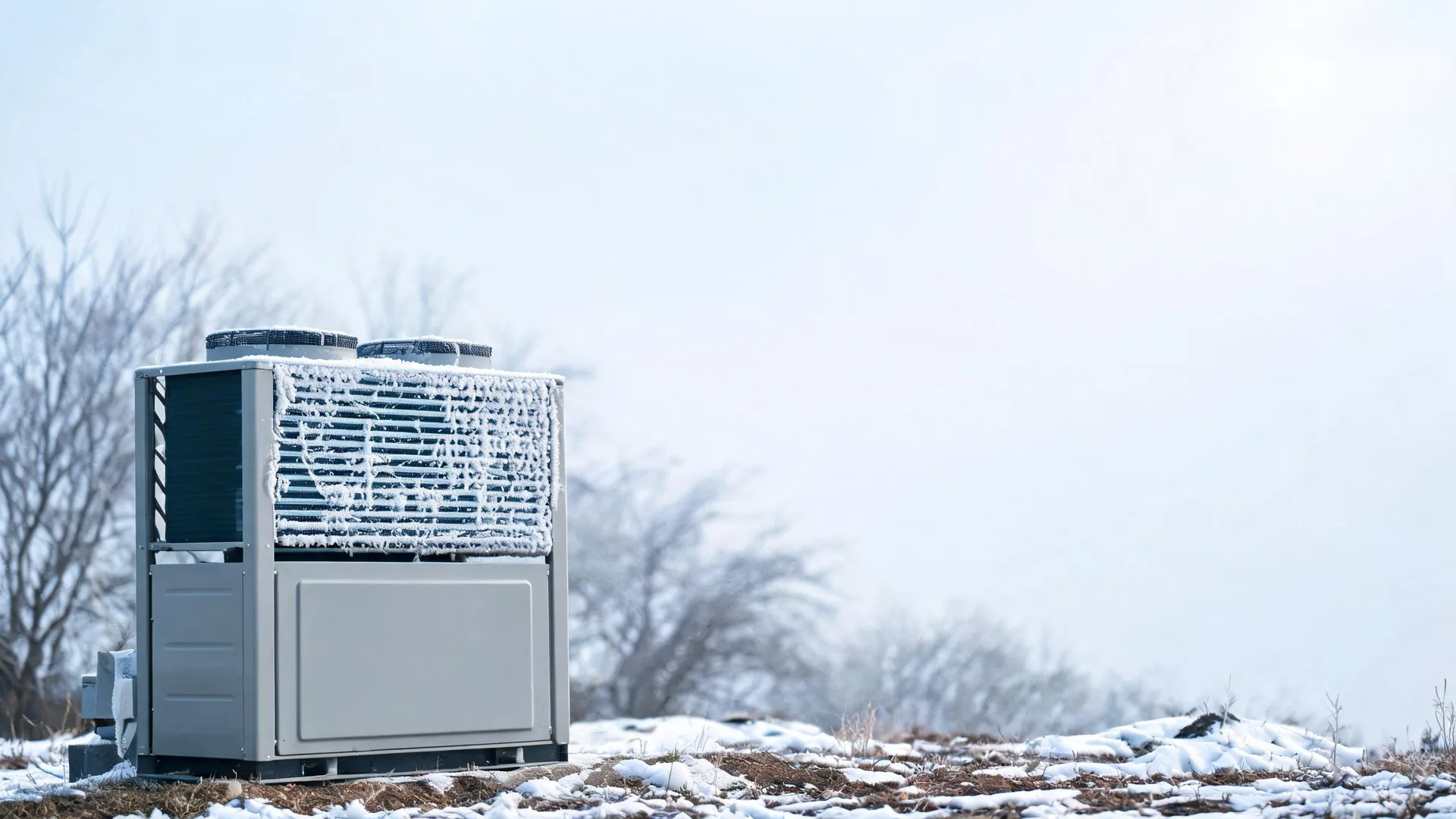
Before you call, there are a few things worth a look. Check the thermostat is set to the right mode and the setpoint actually calls for heat or cooling, since a setting bumped by accident gets mistaken for a broken system all the time. Pull the filter and hold it up to a light. If you can't see through it, swap it, because restricted airflow can make a heat pump freeze up or short cycle and that alone mimics a real failure. Walk outside and look at the outdoor unit. If leaves, grass clippings, or ice are packed against the coil or fins, clear them by hand and give it room to breathe. Check the breaker panel for a tripped switch before you assume the worst, since a reset is free and a service call isn't. If the outdoor coil is caked in ice and the system is in cooling mode, turn it off rather than let it keep running, because ice buildup gets worse the longer the compressor keeps cycling against it.

Age and wear matter more than the calendar year on the unit. A heat pump that's been maintained, with clean coils and a filter changed on schedule, can outlast one that's half its age but got ignored. Repair almost always makes sense when the failure is a single part: a bad capacitor, a stuck reversing valve, a failed sensor. Those are contained problems with a known fix. It starts to lean toward replacement when the compressor itself is the thing failing, since that part isn't usually swapped on its own, or when you're looking at the second or third repair in a short span on the same unit. Ask the technician what actually failed and whether it's an isolated part or a sign the compressor is wearing out. That answer tells you more than anything else about which way to go.