




A twilight street scene featuring illuminated timber-frame and stone houses with a mountain range visible in the background.

Heat Pump Installation in Billings, MT

Tell us about the job

Takes about a minute. No obligation.

New system or replacementHeat PumpYellowstone County, MT
Step 1 of 2

What ZIP code is the job in?

Yellowstone County saw 339 severe weather events between 2015 and 2024. Most of that was wind and hail, 154 damaging wind events and 167 hail events, with one tornado and 17 winter storms mixed in. A heat pump's outdoor unit sits outside through all of it, exposed to whatever the sky does that year. Power is part of the same picture. Statewide, 18% of Montana households lost power for a day or more in 2024. A system that depends on electricity needs a plan for the times the grid doesn't cooperate.

9 months
September through May, your system heats
2 months
July through August, it cools
16°F
the average winter night it heats against
83°F
the average summer afternoon it cools against
Isometric cutaway illustration of a single-story house showing interior ductwork, an indoor air handler, and an outdoor condenser unit connected by lines along the exterior wall.
Your system heats September through May and cools July through August.

NOAA nClimDiv, 1991–2020 normals

Yellowstone County logged 154 damaging wind events and 167 hail events between 2015 and 2024.

The outdoor unit sits through all of that, year after year, so it has to be built and installed for this county's weather.

Most homes here already run on gas, so a heat pump usually joins the furnace rather than replacing it

67.9% of homes heat with gas
Climate zone 6B
Power here costs 14.42 cents per kilowatt-hour
Get it in before SeptemberHeat runs nine months a year here, September through May.

Yellowstone County falls under zone 6B in the 2021 energy code, a cold, dry climate classification that shapes what can legally go into a home here. Any split-system heat pump made from January 2023 onward has to clear federal minimums to be sold at all: at least 14.3 Btu of heat moved per watt-hour of electricity over the summer, and at least 7.5 Btu per watt-hour over the winter. Those numbers set a floor, not a ceiling, so plenty of equipment on the market clears them by a wide margin. A federal tax credit is available for qualifying heat pumps, on top of whatever the unit already has to meet. The contractor sizing the system will know which models qualify for the credit and which ones make sense for this county's winters.

Plan for the outage before you need it

Plan the install around the outage, not just the weather. Ask about a disconnect or transfer switch for a generator, and where the outdoor unit can sit with some cover from wind-blown debris. If the furnace stays in as backup, make sure it can still run on its own when the power's out, since the heat pump can't.

Find a contractor
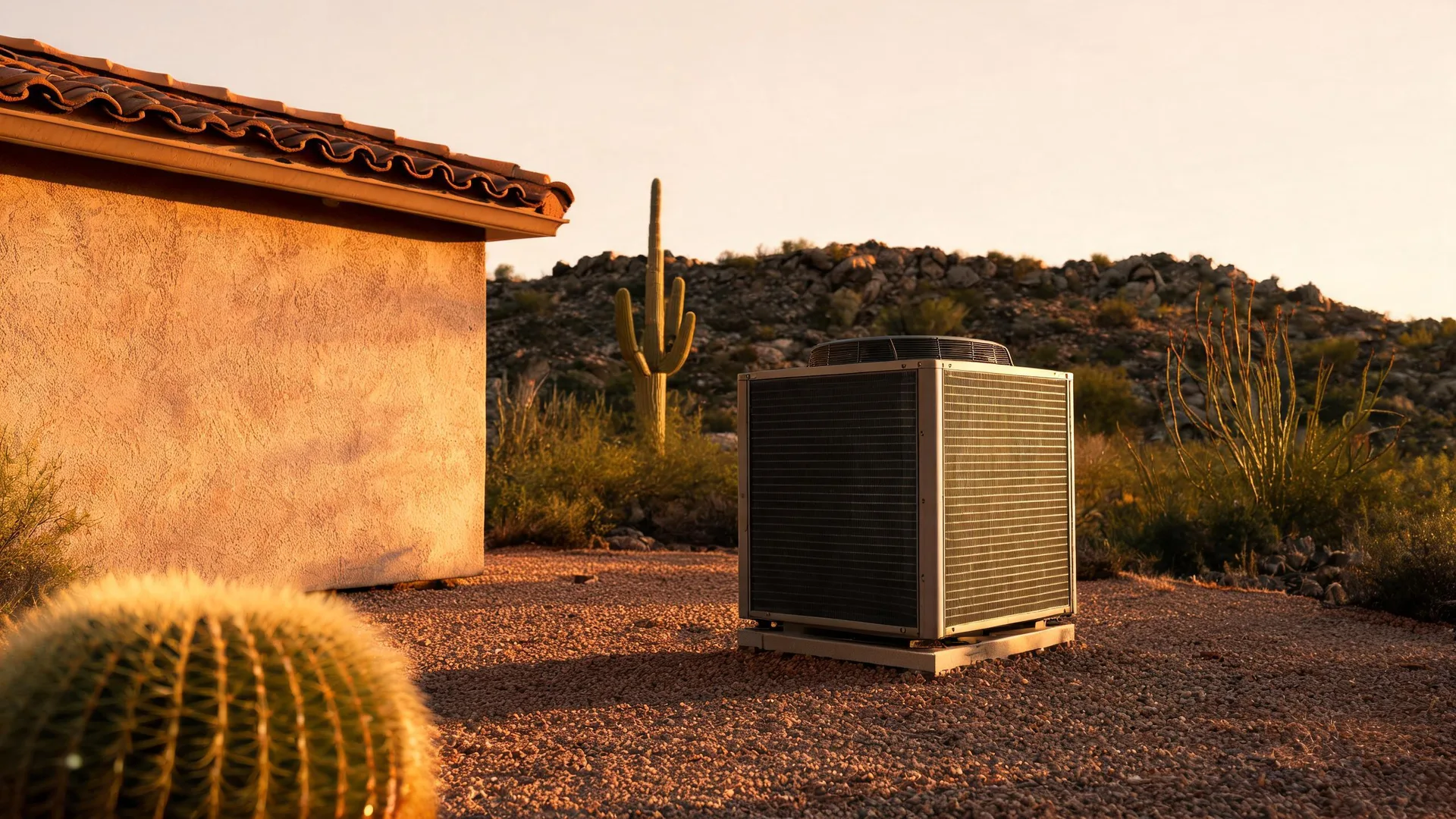
A residential heat pump outdoor unit mounted on a concrete pad next to a house with gray vinyl siding.

Built for what the sky does here

Install it to take the wind and hail, not just the temperature swings. A pad or bracket that's rated for it, conduit and line sets secured so debris can't tear them loose, a spot with some cover if the yard allows one. That outdoor unit runs through every season this county has, and the install is the one chance to decide how well it holds up when the weather turns.

The rating is measured over a season, not a moment

The efficiency number on the label comes from a unit running across a whole season of different conditions, not from one ideal day. A heat pump works hardest at the extremes, the coldest mornings and the hottest afternoons, and coasts the rest of the time. The rating averages all of that together, so it tells you how the system performs over the stretch, not what it can do at its peak.
A higher number changes what you're buying, not just what you'll pay

Equipment built to clear a higher efficiency number usually carries a larger coil, a variable-speed compressor, or both. Those parts change how the system runs day to day: longer, gentler cycles instead of the unit slamming on and off. That's worth knowing when you're comparing models, since the rating on the sticker is really describing the hardware behind it, not just a score.

When you're comparing quotes, don't just look at the number on the sticker. Ask what stage the compressor runs. A single-stage compressor is either on at full output or off, while a two-stage or variable-speed compressor can throttle down and run longer at a lower output, which keeps the house more even and puts less wear on the system. Ask how they're sizing it for your house, not just matching what's already there. A unit that's too big will short-cycle, switching on and off before it really does its job, and one that's too small will run constantly and still fall behind on the coldest days. Ask what happens to heat once the outdoor temperature drops low enough that the heat pump can't keep up on its own, and what takes over at that point. Ask about the warranty on the compressor specifically, since that's the part that costs the most to replace if it fails. And ask what maintenance the manufacturer expects, because skipping it can void coverage even if the system itself did nothing wrong.

Install day starts with the old equipment coming out, if there is any, and the new pad or bracket going in for the outdoor unit. The line set runs between outdoor and indoor units, carrying refrigerant, and it has to be cut, brazed, and sealed on site, then pressure tested before anyone powers the system on. Indoors, the air handler or the existing ductwork gets tied into the heat pump, and if a furnace is staying in as backup, the controls need to be set up so the two share the job instead of fighting each other. The electrical work is its own piece, often a dedicated circuit and disconnect sized for the unit. Once everything's connected, the system gets charged with refrigerant to the manufacturer's specification and run through its paces, heating and cooling both, before the crew walks the homeowner through the thermostat and what to expect from it.