


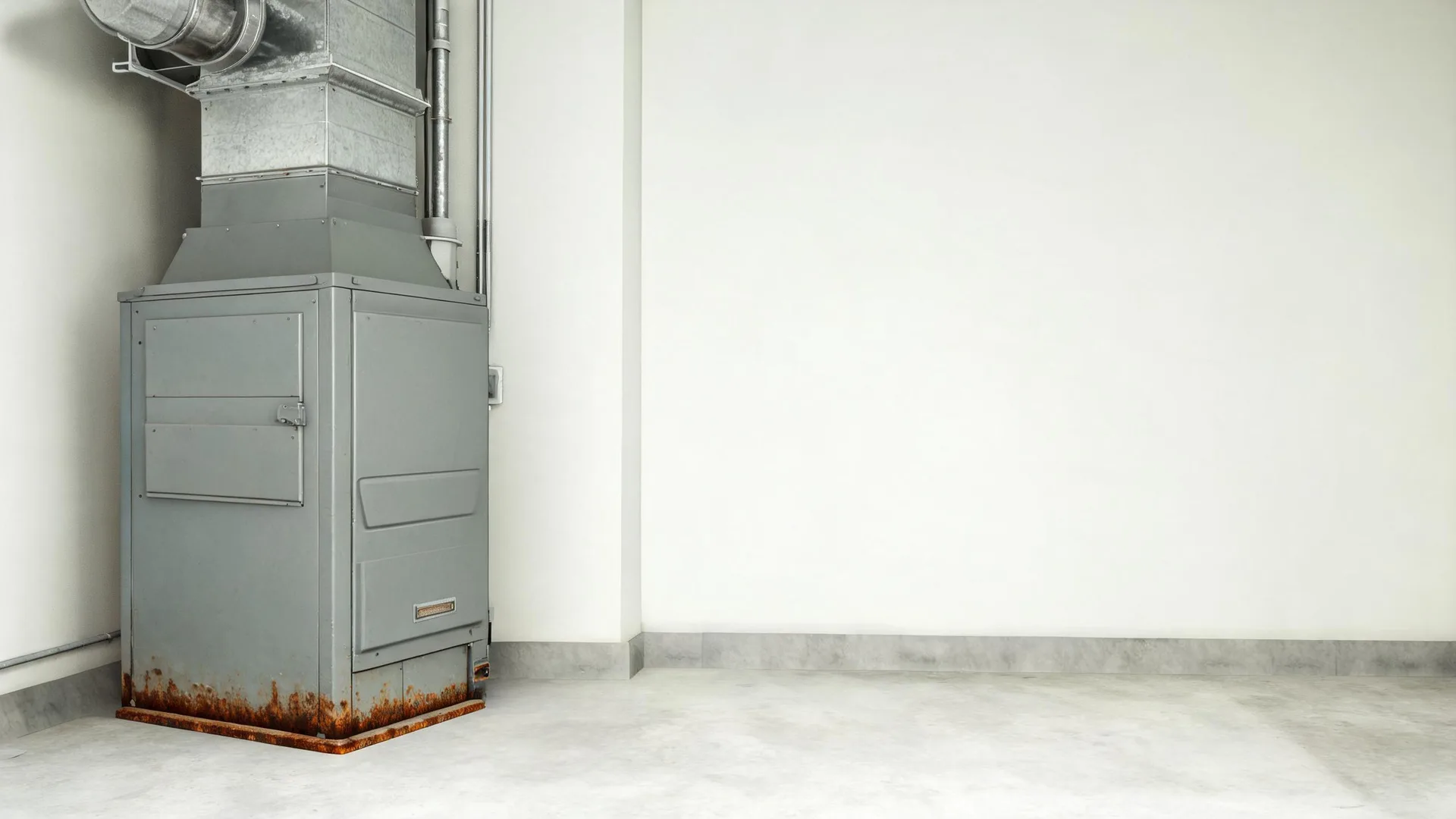
A bare concrete basement containing a gray gas furnace with metal ductwork and a vertical flue pipe, lit by a single hanging bulb.

Furnace Repair in Townsend, MT

Tell us about the job

Takes about a minute. No obligation.

RepairFurnace or heatingBroadwater County, MT
Step 1 of 2

What ZIP code is the job in?

Furnaces in Broadwater County run about ten months a year, September through June. That's most of the calendar, not just a cold snap in January. Overnight lows average 16°F through December, January and February, so the furnace isn't cycling on and off gently, it's holding that line against real cold for hours at a stretch. That kind of runtime adds up on an igniter or a blower motor faster than it would somewhere with a short winter. If yours is making a new noise or not keeping up, it's usually not bad luck. It's wear that caught up with it.

10 months
September through June, your furnace is on duty
16°F
the average winter night it heats against
28 winter storms
in ten years, the nights a failure hurts most
Isometric cutaway illustration of a single-story house showing interior rooms, furniture, a dark furnace unit with a tall vertical flue pipe, and ductwork running under the pitched shingle roof.
Your furnace works hardest from October through April.

NOAA nClimDiv, 1991–2020 normals

Half the homes in Broadwater County were built in 2001 or later.

A furnace that age still has years in it, so the first question is what's wrong, not whether to replace it.

Ten months of heat means September is already a test, not a warm-up

Heat runs September through June
Winter nights average 16°F
Climate zone 6B
The longer it runs rough, the more it costs youPropane in Montana ran $22.28 per million Btu in 2024.

A furnace that runs this many months a year needs a real diagnosis when something's off, not a guess. A tech who knows what ten months of runtime does to an igniter or a blower will check those first, because that's where the hours pile up. Skip that and you can end up paying for a part that was never the problem. Get it looked at properly and the fix holds through the next stretch of 16°F nights, not just until the next cold snap finds the same weak spot.

Fix it now, not after another month of running rough

A furnace burning propane at that rate doesn't get cheaper to ignore. Rough running now means higher cost every day it stays that way. Have it looked at before the next cold stretch asks more of it.

Find a contractor
A gray high-efficiency gas furnace installed in an unfinished basement, surrounded by gas lines, a condensate drain, and sheet-metal ductwork.

The furnace usually tells you what's wrong before it tells you it's done

Most furnace problems announce themselves before the furnace actually quits. Short cycling is one, where it fires up, runs a few minutes, shuts off, then starts again before the house gets warm. That's usually a flame sensor losing its read on the flame, or a filter choking off airflow until a limit switch cuts the burner off early. A burner that won't light on the first try, or lights and then drops out, points to a weak igniter losing its ability to get hot enough. Air coming out lukewarm instead of hot often means the gas valve isn't opening all the way. A low rumble or a screech when it kicks on is usually the blower motor or its bearings telling you they're working harder than they should. Banging or popping from the ductwork as it heats up is normal to a point, but a bang right as the burner lights is often delayed ignition, where gas builds up for a second before it catches. None of these mean the furnace is done. They mean a specific part is wearing out, and a tech can usually name which one before the panel even comes off.

What you can check safely

Start at the thermostat. Make sure it's set to heat and the set point is actually above room temperature, and swap the batteries if it uses them. Then check the filter. Pull it out and hold it up to a light. If you can't see light through it, that's likely starving the furnace of airflow, and you can replace it yourself without tools. Walk around the house and check that supply vents and return grilles aren't blocked by furniture or rugs. Last, check the furnace switch, the one that looks like a light switch near the unit, and make sure it wasn't bumped off.

What to leave alone

Don't take the cover panels off the furnace. Most furnaces have a safety switch that shuts the whole thing down if a panel isn't seated right, so pulling it to look inside can stop the furnace from running at all. If you smell gas, don't go looking for the problem yourself. Leave the house, and call the gas utility or a tech from outside. Same goes for a furnace that trips a breaker more than once. Flipping it back on again and again doesn't fix whatever tripped it, and it can wear on a part that's already failing.

An unfinished basement featuring a forced-air furnace, exposed wooden ceiling joists, bare concrete walls, and miscellaneous items including cardboard boxes and coiled cables on the floor.

A new furnace would cut about $180 a year off heating for a typical Broadwater County home.

  • A new high-efficiency furnace$750 a year
  • An older furnace$930 a year

Estimates for a typical Broadwater County home, compared with an older unit built to the previous federal minimum, from EIA household energy data, Montana fuel prices and NOAA climate normals. Your home will differ.

Repair makes sense when one part has failed and the heat exchanger is sound.

Replacement makes sense when the heat exchanger is cracked or the furnace keeps needing parts.

A furnace is worth fixing almost every time something goes wrong with it. The parts that fail, an igniter, a blower motor, a flame sensor, a gas valve, get replaced on their own without touching the heat exchanger or the cabinet around them. Replacement is really about that heat exchanger. It's the one part a tech can't swap out on its own, and if it's cracked or rusted through, that's the point where fixing it stops making sense. Short of that, a furnace making a new noise or running longer than it used to is usually a worn part doing its job poorly, not a machine at the end of its life. Age alone doesn't decide it. A furnace that's been maintained and never pushed past its limit can outlast one that's been ignored, no matter what the calendar says about either one.